Chronic Pain
Fibromyalgia: strategies to better manage pain
What is fibromyalgia?
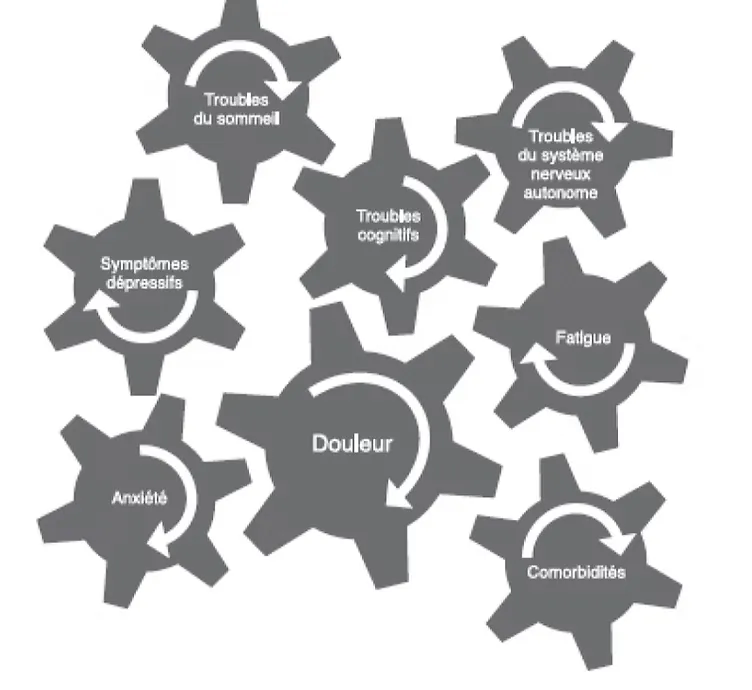
Fibromyalgia, or fibromyalgia syndrome, is a chronic condition characterised by persistent widespread pain and tenderness on pressure. Most often, this pain is associated with other suggestive signs such as persistent fatigue and sleep disturbances.
Fibromyalgia is also accompanied by psychological disorders (anxious-depressive syndromes) and cognitive disorders (difficulties with concentration and attention, forgetfulness, "memory lapses").
In patients with fibromyalgia, there is a deterioration in physical fitness, a significant increase in the perception of effort and a reduction in activities of daily living.
The exact origin of fibromyalgia remains unknown, but scientific research is evolving and has shown an alteration of pain-control pathways in the nervous system.
Symptoms of fibromyalgia
Fibromyalgia manifests itself through a range of symptoms whose intensity can vary. The most common are:
- Generalised pain: the characteristic symptom is pain throughout the body, often described as a dull, diffuse pain that persists for three months or more.
- Fatigue: people with fibromyalgia often feel tired, even if they sleep enough.
- Cognitive difficulties: often called "fibro fog", they include problems with memory, concentration and attention.
- Sleep disturbances: many people with fibromyalgia have difficulty falling asleep or staying asleep due to pain or other associated disorders.
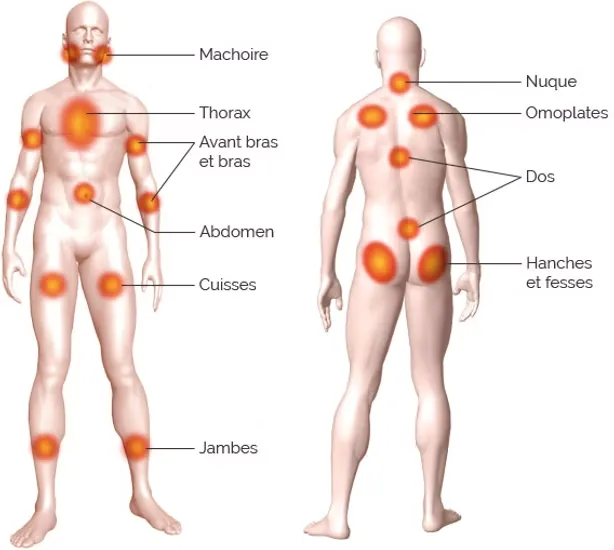
- Painful trigger points: certain parts of the body, such as the neck, shoulders, back and hips, may be particularly sensitive to touch.
- Other symptoms: headaches, irritable bowel syndrome (IBS), joint hypermobility, anxiety and depression are often associated with fibromyalgia.
Understanding fibromyalgia: a disorder of pain modulation
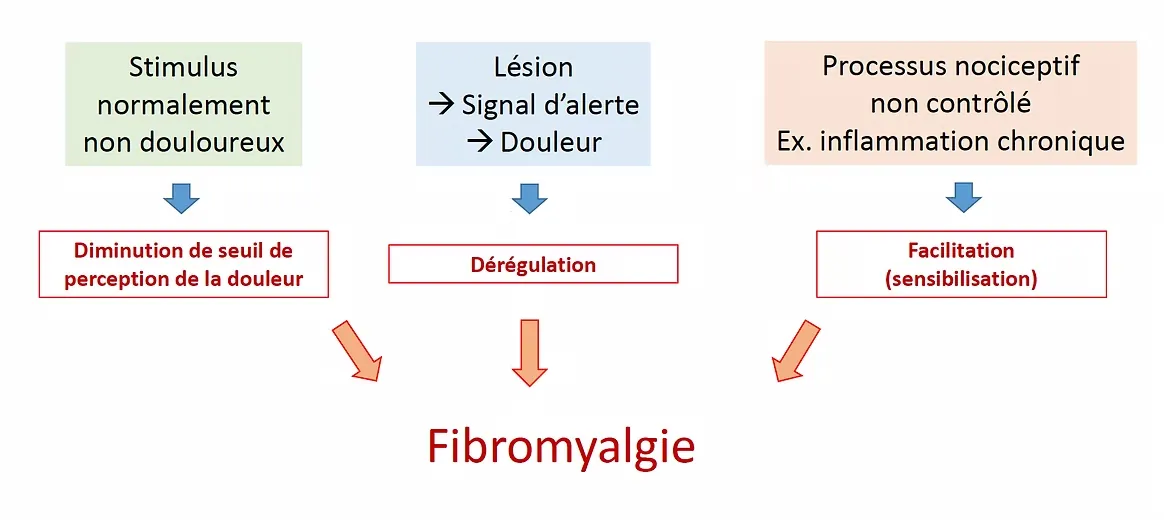
Fibromyalgia is neither a joint disease nor an inflammation of the muscles: it is a disorder of how the nervous system processes pain. In affected people, the mechanisms that amplify pain signals and those that dampen them are out of balance — a phenomenon grouped under the term central sensitisation. The nervous system becomes more reactive: normally non-painful stimuli can be felt as painful, and pain is perceived in an amplified way.
This amplification explains the diffuse, fluctuating nature of the pain, often accompanied by fatigue, sleep disturbance and difficulty concentrating. Stress, lack of sleep and inactivity tend to maintain this imbalance, whereas suitable physical activity, better-quality sleep and stress management help to restore it.
How is fibromyalgia diagnosed?
The diagnosis of fibromyalgia is clinical: it rests on the history and examination, without any specific laboratory test or imaging. The current criteria (2016 revision of the American College of Rheumatology criteria) take into account the widespread nature of the pain, its duration (beyond three months) and associated symptoms such as fatigue, sleep disturbance and cognitive difficulties.
An essential step is to rule out other causes that could explain the symptoms. Diagnosis is the role of the GP and, where needed, the rheumatologist; the osteopath acts as a complement, once the diagnosis has been made.
Treatment of fibromyalgia
Recommendations of the European League Against Rheumatism (EULAR)
In its revised recommendations, the European League Against Rheumatism (EULAR) advocates a comprehensive, graded and personalised approach. Key point: the only "strong" recommendation is physical exercise. Initial management rests on patient education and non-pharmacological approaches, with medication reserved for certain situations. As the size of the benefit remains modest, the value lies in combining several levers:
- Education and self-management: patients should be informed about fibromyalgia, in particular about its symptoms, therapeutic options and coping strategies.
- Multidisciplinary approach: treatment should involve a team including rheumatologists, physiotherapists, psychologists and occupational therapists.
- Physical activity: regular physical activity can help reduce pain and improve physical function.
- Cognitive behavioural therapy (CBT): helps patients manage stress, anxiety and depressive symptoms.
- Sleep management: education on sleep hygiene and interventions where necessary.
- Complementary therapies: acupuncture, mindfulness, yoga and massage in addition to conventional treatment.
Physical exercise: the cornerstone of treatment
Suitable physical activity is the best-supported intervention in fibromyalgia. Practised regularly, aerobic exercise (walking, cycling, swimming) helps improve quality of life, pain and functional capacity. The golden rule is gradual progression: start at a comfortable intensity and increase it very gradually to avoid flare-ups. Consistency matters more than intensity. Adapted exercises can be suggested in consultation.
The place of osteopathy and manual therapy
Manual approaches may be offered as a complement, to help release muscular tension, soothe and support relaxation. The available evidence is limited and varies by technique: some myofascial release approaches show favourable effects on pain, while others provide no demonstrated benefit. Manual therapy therefore does not replace the cornerstones that are exercise and education, but can be integrated with them to improve comfort and ease the return to movement.
Therapeutic education and self-management
Understanding your fibromyalgia is itself part of the care. Therapeutic education helps you identify your triggers, pace your effort, protect your sleep and manage stress — all levers that act directly on the mechanisms of pain. The aim: to become an active participant in your care and regain day-to-day autonomy.
Osteopathy and fibromyalgia: how to relieve the pain?
An osteopath specialising in chronic pain understands the neurophysiological particularities of fibromyalgia: central sensitisation, fluctuations of the pain threshold, and the impact of stress on pain. Thanks to this expertise, they adapt their techniques (gentle mobilisations, visceral approaches, breathing exercises) to provide relief without over-stimulating already sensitive tissues.
Above all, this practitioner integrates therapeutic patient education (TPE): they explain to you the mechanisms of fibromyalgia, teach you to identify your triggers, to manage effort, posture, sleep and stress, and give you simple self-exercises to prolong the relief between sessions.
Mr Charbel J. Kortbawi, in addition to his osteopathic care, is qualified thanks to his specialist training to deliver therapeutic patient education for the fibromyalgic patient, and to help them find a physical activity programme adapted to their condition.
Scientific references
- Macfarlane GJ, et al. EULAR revised recommendations for the management of fibromyalgia. Ann Rheum Dis. 2017;76(2):318-328. doi.org/10.1136/annrheumdis-2016-209724
- Wolfe F, et al. 2016 Revisions to the 2010/2011 fibromyalgia diagnostic criteria. Semin Arthritis Rheum. 2016;46(3):319-329. doi.org/10.1016/j.semarthrit.2016.08.012
- Sluka KA, Clauw DJ. Neurobiology of fibromyalgia and chronic widespread pain. Neuroscience. 2016;338:114-129. doi.org/10.1016/j.neuroscience.2016.06.006
- Clauw DJ. Fibromyalgia: a clinical review. JAMA. 2014;311(15):1547-1555. doi.org/10.1001/jama.2014.3266
- Bidonde J, et al. Aerobic exercise training for adults with fibromyalgia. Cochrane Database Syst Rev. 2017;6(6):CD012700. doi.org/10.1002/14651858.CD012700
- Yuan SLK, Matsutani LA, Marques AP. Effectiveness of different styles of massage therapy in fibromyalgia: a systematic review and meta-analysis. Man Ther. 2014;20(2):257-264. doi.org/10.1016/j.math.2014.09.003
Frequently Asked Questions
FAQ
Can osteopathy help manage fibromyalgia?
Osteopathy and manual therapy may be offered as a complement, to help release muscular tension and support relaxation. The evidence remains limited and varies by technique: they do not replace the cornerstones of treatment, which are suitable exercise and patient education.
How many osteopathy sessions for fibromyalgia?
Fibromyalgia calls for personalised, long-term care. The techniques used are gentle and gradual, so as not to over-stimulate already sensitive tissues. The number of sessions is adjusted to each person, always alongside physical activity and therapeutic education.
Can fibromyalgia be diagnosed by an osteopath?
No, the diagnosis of fibromyalgia is medical: it is based on clinical criteria (2016 revision of the American College of Rheumatology criteria). The osteopath acts as a complement, once the diagnosis has been made by the GP or rheumatologist and other causes have been ruled out.
What physical exercises are recommended for fibromyalgia?
Gentle, regular physical activity is the cornerstone of fibromyalgia treatment. Walking, swimming, yoga and tai chi are particularly beneficial. Intensity should be increased gradually to avoid flare-ups. A personalised exercise programme can be designed in consultation.